Cawthron researchers join global search for next-generation skincare ingredients
05 June 2026
Researchers from Cawthron Institute and Callaghan Innovation’s Biotechnology Research Group have joined an international consortium to explore the country’s vast ocean territory for marine microorganisms that could produce breakthrough ingredients for the global skincare industry.
The Programme will use artificial intelligence, genomic screening and biotechnology tools to identify novel bioactive compounds from marine microorganisms, targeting applications in high-value skincare formulations including anti-inflammatory, antioxidant, UV-protecting and skin barrier products.
New Zealand’s participation focuses on the country’s unique and largely unexplored marine biodiversity. Cawthron will lead research into marine microalgae, while Callaghan Innovation’s Biotechnologies Group will study marine bacteria from New Zealand waters – including samples from pristine coastal, sub-Antarctic and subtropical environments.
Dr Johan Svenson, Science Impact Manager at Cawthron Institute, says New Zealand sits at the edge of some of the most biologically diverse and least studied ocean environments on earth.
“This project gives us the tools and the international partners to start unlocking what may be a remarkable natural resource – with real potential for commercial outcomes that benefit New Zealand.”
“Being selected as part of a Horizon Europe consortium is a significant recognition of the quality of New Zealand’s marine science and an exciting first for Cawthron Institute – we’re proud to bring our expertise to this global programme.”
Svenson says the consortium is grateful for the support received from MBIE, who fund and manage New Zealand’s association to pillar II of Horizon Europe on behalf of the Government, enabling New Zealand researchers to lead and participate in projects addressing major global challenges.
Paul Rose, Biotechnologies Group Leader, Callaghan Innovation, says New Zealand’s marine biodiversity is a ‘treasure trove’ of unexplored opportunity.
“Marine bacteria are extraordinarily diverse biochemical factories. New Zealand’s waters offer access to microbial ecosystems that simply don’t exist anywhere else in the world. Through OCEOMICS, we have the opportunity to screen these organisms at scale using AI-driven tools that would have been unimaginable a decade ago.”
Anaru Luke, Cawthron Institute’s Pou Arataki (Chief Māori, Indigenous & Transdisciplinary Partnerships Officer) says the project has been designed from the outset in accordance with New Zealand’s legal, ethical and Treaty obligations.
“What’s unique about this project is that sampling will proceed subject to agreement with iwi, guided by Te Tiriti-based principles including partnership, kaitiakitanga, and respect for mātauranga Māori.”
“Critically, no organisms will leave New Zealand. Only extracts and genomic data will be shared with consortium partners, and all genomic and metabolomic data will be stored and stewarded in New Zealand to support data sovereignty.”
Luke says any commercially promising strains will be characterised in New Zealand, and downstream commercial benefits will be shared with participating iwi.
“Iwi are invited to participate in any part of the New Zealand programme – including sampling, research, and product development – and to grow their own knowledge of marine biodiscovery and the emerging blue bioeconomy.”
_____
Find out more about the Programme here: OCEOMICS explores marine biodiversity for cosmetic bioactives
About OCEOMICS
OCEOMICS (Ocean-derived bioactive compounds for skincare applications) is funded through Horizon Europe and brings together research institutes, universities and industry partners from Spain, New Zealand, and six other countries. The consortium spans the full value chain from marine sampling and AI-driven discovery through to bioproduction, formulation and commercial validation. The project integrates Safe and Sustainable by Design principles and the Nagoya Protocol on access and benefit-sharing of genetic resources.
The global project launch is being coordinated by consortium lead AINIA and project partner Innovarum, with an international announcement to coincide with the project’s official kick-off meeting in Valencia, Spain on 4-5 June. This New Zealand release is intended to align with that global announcement.
About Cawthron Institute
Cawthron Institute is New Zealand’s largest independent science organisation, based in Nelson. Cawthron is internationally recognised for its expertise in aquatic science, including marine and freshwater research, aquaculture, and natural products. OCEOMICS marks Cawthron’s first successful participation in Horizon Europe — the world’s largest international research funding programme. New Zealand became an associated country in Horizon Europe Pillar 2 in 2023, the first country outside the European region to do so, opening the door for NZ organisations to join and lead projects on equal terms with European partners. [www.cawthron.org.nz]
About Callaghan Innovation’s Biotechnologies Group
The Biotechnologies Group accelerates the pathway from breakthrough science and engineering concepts to applied solutions in the market. The group hosts critical capabilities for New Zealand’s science ecosystem, notably the most comprehensive and versatile microbial fermentation suite and associated downstream processing capabilities in the New Zealand science system, combined with leading protein and enzyme science.
OCEOMICS represents the group’s first participation in Horizon Europe and bolsters their continued commitment to international research collaboration and the emerging blue bioeconomy [www.callaghaninnovation.govt.nz/products/solve/].
Funding for the Biotechnologies group has been extended through to 30 June 2027. The group will continue signing new contracts and delivering its full suite of services to both existing and new customers, as it transitions to the New Zealand Bioeconomy Science Institute (BSI) Public Research Organisation (PRO).
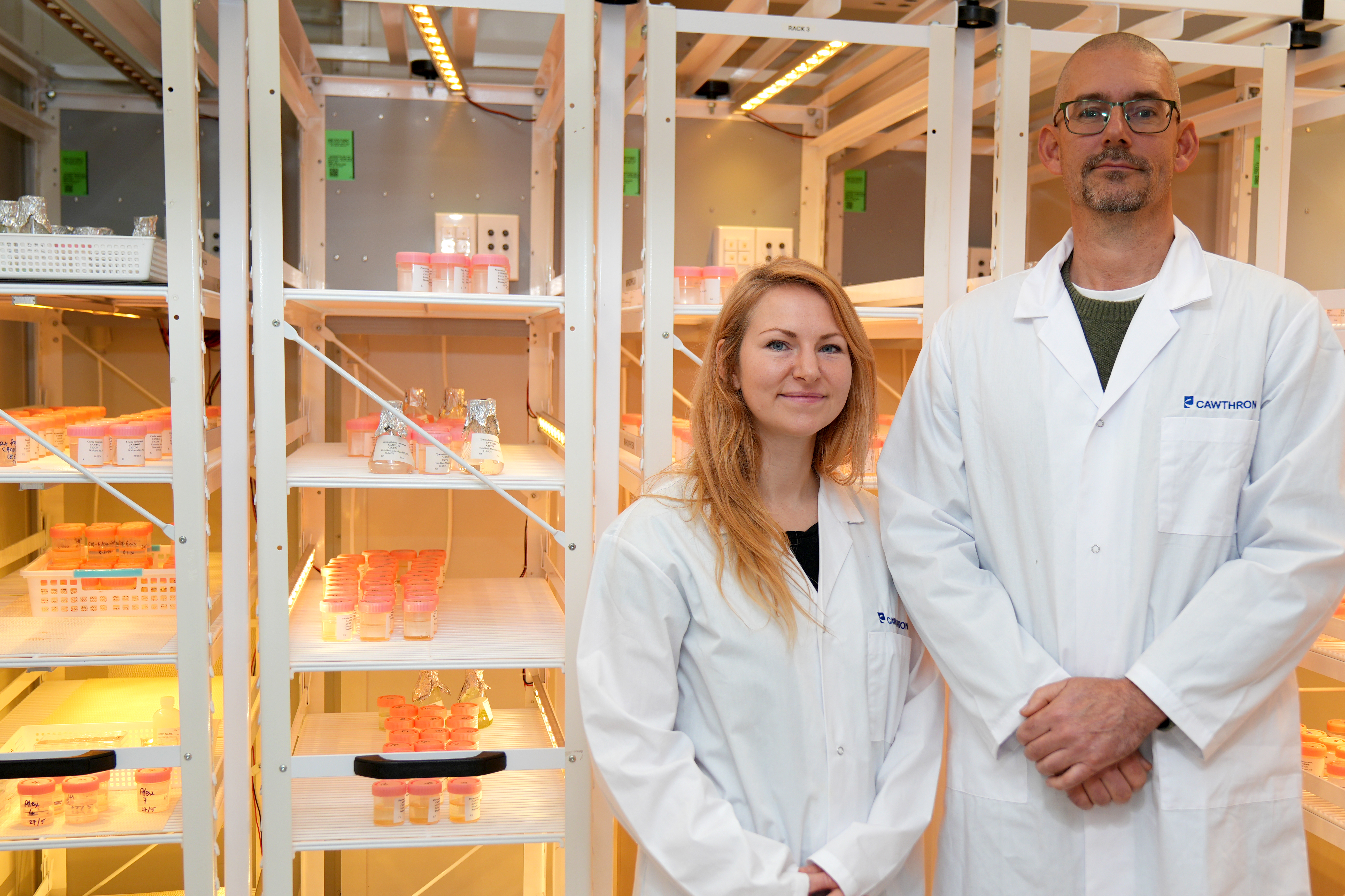
Image: Dr Cora Hertzer and Dr Johan Svenson, in Cawthron Institute’s Culture Collection laboratory.